
• FB
  • IG
  • SF
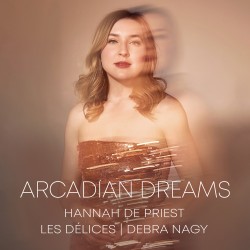
Arcadian Dreams
Title:

Arcadian Dreams

Artists:

Les Délices
Hannah De Priestsoprano
Debra Nagy, baroque oboe
Shelby Yamin & Kako Boga, violins
Rebecca Landell, cello & viola da gamba
Mark Edwards, harpsichord

Release Date:

13th March 2026

Cat No:

AV2831 | 822252283129 (CD & Digital)

Price:

£13.49 (1CD Jewel Case) – PRE-ORDER

Summary:

Soprano Hannah De Priest makes her recording debut alongside early music ensemble Les Délices, with Arcadian Dreams, an album of baroque-era secular cantatas and scintillating instrumental works.

line

Arcadian Dreams: the title conjures pastoral perfection, an idyllic vision rooted in Greek mythology. Equally, it references the Arcadian Academy established in Rome in 1690, a vibrant hub of intellectual and artistic creativity whose influence quickly spread across Europe.

Arcadian Dreams assembles an exquisite group of composers – both esteemed and inspired – including the French luminaries Thomas-Louis Bourgeois, Louis Antoine Lefebvre, and Jean-Philippe Rameau; the Neapolitan maestro Domenico Scarlatti, who lived his last 35 years in Spain; and the German-born George Frideric Handel, whose early Italian career left an indelible mark on his masterpieces.

The enchanting realm of Arcadian Dreams abounds with gods and goddesses, shepherds and nymphs, and bucolic dreamscapes creating an aural tapestry of pictorial, secular cantatas intertwined with entrancing instrumental numbers. The fearless young soprano Hannah De Priest, making her recording debut, vividly captures the essence of these beguiling works, alongside the entrepreneurial early music ensemble Les Délices whose members bring long-forgotten music alive for contemporary audiences.

line

In the 18th-century, Arcadia was a byword for a kind of pastoral perfection; an idealized vision where nature and humanity hung in perfect balance. According to Greek Mythology, Arcadia was a highland region at the center of the Peloponnese where Pan reigned over the wilderness, oversaw shepherds and their flocks, and played music on his pipes while seducing nymphs.

Besides bucolic dreamscapes, Arcadian Dreams references Rome’s Arcadian Academy. Founded in Rome in 1690 under the patronage of Queen Christina of Sweden, the Arcadian Academy became an intellectual home for poets, visual artists, and musicians who dedicated themselves to aesthetic values like truth and simplicity inspired by Classical form and function. Taking Pan’s pipes as their emblem, the Arcadian Academy quickly established itself as a multi-disciplinary institution of artists, poets, and musicians whose influence would be felt across the European continent and remain a leading cultural force for centuries. France, for instance, experienced a wave of interest in the secular cantata and instrumental sonata as manuscript copies of music by Arcadian Academy members Giovanni Bononcini and Arcangelo Corelli circulated in Paris’ exclusive salons in the decades on either side of 1700.

Primarily remembered today as a titan of French opera, Rameau first experimented with dramatic music via the small-scale secular cantata. Studded with keening dissonances and chromaticism, Rameau’s Le Berger fidèle (the faithful shepherd) begins with a lament “Faut-il qu’Amarillis périsse” (Must Amarillis die?) that vividly portrays a shepherd’s distress at the goddess Diana’s dictate that he sacrifice his lover. A dramatic accompanied recitative “Cependant à l’autel” (while at the altar) sees the shepherd try to save his Amarillis by offering himself to the virgin goddess. Deeply moved by his fidelity and ardor, Diana spares both Mirtil and Amarillis so that their union may be blessed by Hymen, God of Marriage. The final, celebratory air “Charmant amour” (Charming love) observes that we often arrive at happy circumstances through tenacity and perseverance.

In the same way that Rameau’s cantatas are overshadowed by his operas, George Frederic Handel’s cantatas are fabulous, dramatic miniatures that are heard only infrequently today. Handel’s cantatas date primarily from the early years of his career – particularly his time in Rome (1707-1710), where the cantata and oratorio flourished since opera was (for a time) forbidden by papal edict. As the only musical genre that he refrained from publishing, scholar Ellen T. Harris considers Handel’s cantatas a sort of “private” music as they were written expressly for individual patrons. Unsurprisingly, Handel’s cantatas reflect his absorption of the musical styles of father and son Alessandro and Domenico Scarlatti, Giovanni Bononcini, and Arcangelo Corelli.

Harris has further observed, “the music of the cantatas is, at its core, about longing—frequently for a love that one cannot have,” and the texts frequently feature thinly-veiled eroticism. Handel’s Mi palpita il cor begins with a sort of panting breathlessness that gives way to wailing and agitation. Meanwhile, the tormenting “pains” of the second aria “Ho tanti affanni” contrast with Handel’s musical setting in tantalizing ways. Set in a lilting 6/8 meter that is generally associated with pleasure and full of gravity-defying leaps in the oboe and sweet chains of suspensions, the shepherd’s supposed misery seems obviously to be the object of his desires. Following anintercession to Cupid (son of Venus), a hopeful final aria in Bb major exalts in ecstatic vocal flourishes on the word “contento” (contentment).

While Thomas-Louis Bourgeois (1676-1750) is hardly a household name, he made a major contribution to the genre of the French cantata: he composed over 40 cantatas beginning in 1708 and continuing through the late 1740s. In his heyday, Bourgeois sang countertenor at Paris’s Opéra and worked for six years as surintendant de musique in the service of the Duke of Bourbon where he rubbed shoulders with other musical trendsetters who were busy refashioning the latest Italian music for French sensibilities. By the end of his career, however, Bourgeois seems to have struggled to hold onto professional appointments in various provincial cities (Lyons, Poitiers, Dijon) such that his career ended in obscurity and poverty. Bourgeois’ Diane et Endimion transports us to the romantic shadows of night. Sister to “the most brilliant of the gods” (Apollo), Diana encompassed multiple identities: she was at once Goddess of the Moon (and thus fertility and childbirth), a divine huntress overseeing both woods and countryside, and Goddess of the Underworld. In Bourgeois’ cantatille (the official term for a short cantata comprising just two recitatives and arias), Diana happens upon the sleeping shepherd Endymion and instantly falls in love with him. She’s frustrated by his state of unconsciousness, however, and admonishes him for missing out on her visit. The final air “Une frayeur mortelle” (a mortal fear) bristles with energy that suggests not only the rushing flight of Diana’s carriage as dawn approaches but also Endymion’s anxious emotional state.

According to 18th-century biographer John Mainwaring, Cardinal Pietro Ottoboni brought together Handel and Domenico Scarlatti for a “trial of skill” when the two were just twenty-four years old. Though Scarlatti apparently conceded Handel’s superiority on the organ, Scarlatti’s ingenuity and technical prowess are clear from the 555 keyboard sonatas that he wrote during the last 35 years of his life that he was employed by the court of Spain. Written as a single binary movement, his Sonata in d minor K.213 alternates painful chromaticism with wistfulness.

A contemporary of Rameau, Louis Antoine Lefebvre takes similar care with orchestration and dramatic detail. Beginning with an evocative prelude depicting sunrise,Le lever de l’Aurore transports the listener from the dusky, muted tones of A minor to a brilliant, shining E major chord that ushers in Aurora, the Goddess of the dawn. According to the carefree opening aria “L’Olimpe se d’ore,” she inspires the birds to sing and spreads flowers across the earth, leaving pearls and opals in her wake. A Musette (whose drones imitate a shepherd’s bagpipe) calls the young shepherds, Phyllis and Titire, to the meadow so that they and their flocks might enjoy each other’s sweet company.

Tracklist:

JEAN-PHILIPPE RAMEAU (1683–1764)
Le Berger Fidèle
01.
Récit: Prest à voir immoler
02. Air Plaintif: Faut-il qu’Amarills périsse?
03. Récit: Mais c’est trop me livrer
04. Air gai: L’Amour qui regne dans vos âme
05. Récit: Cependant à l’autel
06. Air vif et gracieux: Charmant Amour

GEORGE FRIDERIC HANDEL (1685–1759)
Mi Palpita il cor 
07. Recit: Mi palpita il cor
08. Aria: Agitata è l’alma mia
09. Recit: Tormento e gelosia
10. Aria: Ho tanti affanni in petto
11. Recit: Clori di te me lagno
12. Aria: S’un di m’adora

TOMASO ALBINONI (1671–1751)
Sonata for oboe & continuo in C major 
13. Adagio
14. Allegro
15. Bourlesque
16. Menuet

THOMAS LOUIS BOURGEOIS (1676-1750)
Diane et Endimion 
17. Récit: Tandis que fatigué
18. Air: Des plus doux plaisirs
19. Récit: Ah! Dit la tendre soeur
20. Air: Une frayeur mortelle

DOMENICO SCARLATTI (1685–1757)
21. Sonata in d minor, K213

LOUIS LEFEBVRE (1700–1763)
Le Lever de l’Aurore 
22. Récit: L’Astre que le silence suit
23. Air leger: L’Olimpe se dore
24. Musette: Jeune Titire, éveillez-vous
25. Récit: Ces amans conduits par l’Amour
26. Air gay: Que vôtre destin à d’appas

LES DÉLICES
Hannah De Priest, soprano
Debra Nagy, baroque oboe
Shelby Yamin & Kako Boga, violins
Rebecca Landell, cello & viola da gamba
Mark Edwards, harpsichord

Related Releases: