


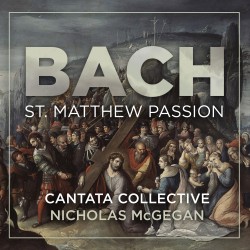
Bach: St Matthew Passion
Cantata Collective
Nicholas McGegan
Thomas Cooley, tenor
Paul Max Tipton, bass-baritone
Sherezade Panthaki, soprano
Reginald Mobley, countertenor
James Reese, tenor
Harrison Hintzsche, baritone
3rd April 2026
AV2840 | 822252284027 (3CD & Digital Spatial Audio)
£34.99 (3CD Deluxe Digipack | 48-page booklet)
Summary:
“The gathered forces are both stylish and alert, with the instrumentalists offering lithe, responsive playing and a continuo team that propels the narrative at a well-judged, lively pace: chorales are shaped with dignity, and the broader architecture is, as always with McGegan, beautifully drawn.” – Ashutosh Khandekar, BBC Music magazine
“The sound quality…is particularly successful. Captured live but virtually free of audience noise, the recording preserves a very natural sense of space while maintaining an excellent level of instrumental detail. Voices are clearly projected and well separated without any sense of dryness, and the balance consistently supports the intelligibility of the counterpoint. It is a recording that does not aim to impress through sonic spectacle, but rather to quietly serve a musically coherent and carefully considered project.” ★★★★ – Islem Maghiref, AllMusic.com
“The St Matthew Passion cannot succeed without a first-rate Evangelist. Tenor Thomas Cooley … comes through impressively… Cooley presents the narrative with eloquent expressiveness… All of the other solo singers are very fine. McGegan delivers a coherent and shapely performance of this huge masterpiece…” Gatens, American Record Guide
“The sheer quality of the vocal and instrumental performances under the absolutely first-rate direction of Nicholas McGegan makes this three-CD release from AVIE an outstanding one.”★★★★ – Mark Estren, Infodad.com
“This is an emotionally subtle Passion … Cooley is an involved and attentive vocalist-narrator … Countertenor Reginald Mobley brings refined singing-acting to Bach’s alto arias… Sherezade Panthaki’s soprano excels in arias like “Ich will dir mein Herze schenken.“ Here it’s a youthful declaration of faith that never turns frivolously bright; her voice’s colorful edges pair especially well with Cantata Collective’s winds.” – Andrew J. Sammut, Early Music America
“His [McGegan] efforts have been instrumental in bridging the gap between academic historical performance and emotionally resonant, accessible music-making… McGegan and company fine tune the narrative aspect of the work by modulating its dramatic momentum. The performance is warm and organic, providing a fecund environment for the excellent soloists to work… The sonics are superb” - C Michael Bailey, Wild Mercury Rhythm
“… Paul Max Tipton, has a wonderful voice for the role [Christ]… the warmth and humanity are there in full … An Evangelist needs clarity and diction, an engagement with the life of the text, and most importantly an ability to create a sense of empathy with the characters, especially Jesus. Cooley manages all of this … His is a fine performance …” – Steve Gladwin, MusicWebInternational.com
“Like previous Cantata Collective recordings of Bach’s choral works, this is a beautifully recorded and performed performance … Conductor Nicholas McGegan once again leads this work as if it were one of the easiest works in all of classical music. So effortlessly do the double orchestra and double choir come together…” Craig L Byrd, The Cultural Attaché
“After listening to this new release several times, I have come to enjoy the overall experience.” - Stephen Smoliar, TheRehearsalStudio.blogspot
“… by turns expressive and contemplative… sumptuous presentation …” – Anne Carlini, Exclusive magazine
“among the excellent features is the singing of bass-baritone Paul Max Tipton as Jesus… Such expressiveness holds fast throughout this performance … Also impressive is how well-defined the choral diction is … this performance embodies the support of faith intended by Bach and his librettist, while presenting a consistent and scrupulous interpretation” – James Harvey, Jay Harvey Upstage blogspot
“… [the orchestra] produce subtle nuances of articulation, meaningful phrasing, and a cohesive sound… he [McGegan] eschews superficial effects entirely, delivering instead a highly focused interpretation of the ‘St Matthew Passion’ that prioritises rhetorical expression and aptly captures the spirit of the work… this is a production that shows promise …” Music ★★★½ Sound ★★★★ – Matthias Hengelbrock, Fono Forum

Cantata Collective and Nicholas McGegan continue their series of J. S. Bach’s choral masterworks with the composer’s masterful St. Matthew Passion for double choir and double orchestra.
The Bay Area-based Cantata Collective, under the direction of Nicholas McGegan, launched their series of J.S. Bach’s large-scale choral masterworks with a “bold and beautifully constructed” St. John Passion (BBC Radio 3 Record Review). The Mass in B Minor, and the Easter Oratorio paired with Magnificat, followed to equally glowing acclaim, setting the stage for the other of Bach’s great Passions, the masterful St. Matthew Passion for double choir and double orchestra. Completing the cast is the Cantata Collective’s own chorus, the inspirational San Francisco Girls Chorus, and a superlative sextet of soloists – tenor Tom Cooley as the Evangelist, bass-baritone Paul Max Tipton as Jesus, baritone Harrison Hintzsche as Pilatus, soprano Sherezade Panthaki as Pilatus’ wife, alto Reginald Mobley and tenor James Reese.
With texts blending gospel with poetry, the recording – captured live in the glowing acoustic of Berkeley, California’s First Church – is by turns expressive and contemplative. Presented across three CDs and available digitally in Dolby Atmos, the sumptuous presentation includes insightful booklets notes by Daniel R. Melamed, esteemed Bach scholar and President of the American Bach Society.
Tracklist:
JOHANN SEBASTIAN BACH (1685–1750)
St. Matthew Passion, BWV 244
CD 1 | Part 1
01. No. 1, Chor. “Kommt, ihr Töchter helft mir klagen”
02. No. 2, Rezitativ. “Da Jesus diese Rede vollendet hatte”
03. No. 3, Choral. “Herzliebster Jesu, was hast du verbrochen”
04. No. 4, Rezitativ. “Da versammleten sich die Hohenpriester”
05. No. 5, Rezitativ. “Du lieber Heiland du”
06. No. 6, Aria. “Buß und Reu”
07. No. 7, Rezitativ. “Da ging hin der Zwölfen einer”
08. No. 8, Aria. “Blute nur, du liebes Herz!”
09. No. 9, Rezitative und Chöre. “Aber am ersten Tage der süßen Brot”
10. No. 10, Choral. “Ich bin’s, ich sollte büßen”
11. No. 11, Rezitativ. “Er antwortete und sprach”
12. No. 12, Rezitativ. “Wiewohl mein Herz in Tränen schwimmt”
13. No. 13, Aria. “Ich will dir mein Herz schenken”
14. No. 14, Rezitativ. “Und da sie den Lobgesang gesprochen hatten”
15. No. 15, Choral. “Erkenne mich, mein Hüter”
16. No. 16, Rezitativ. “Petrus aber antwortete und sprach zu ihm”
17. No. 17, Choral. “Ich will hier bei dir stehen”
18. No. 18, Rezitativ. “Da kam Jesus mit ihnen zu einem Hofe”
19. No. 19, Rezitativ und Choral. “O Schmerz! Hier zittert das gequälte Herz!”
20. No. 20, Aria mit Chor. “Ich will bei meinem Jesu wachen”
21. No. 21, Rezitativ. “Und ging hin ein wenig”
22. No. 22, Rezitativ. “Der Heiland fällt vor seinem Vater nieder”
23. No. 23, Aria. “Gerne will ich mich bequemen”
24. No. 24, Rezitativ. “Und er kam zu seinen Jüngern”
25. No. 25, Choral. “Was mein Gott will, das g’scheh allzeit”
26. No. 26, Rezitativ. “Und er kam und fand sie aber schlafen”
27. No. 27, Aria und Chor. “So ist mein Jesus nun gefangen”
28. No. 28, Rezitativ. “Und siehe, einer aus denen”
29. No. 29, Choral. “O Mensch, bewein’ dein’ Sünde groß”
CD 2 | Part 2
01. No. 30, Aria mit Chor. “Ach, nun ist mein Jesus hin!”
02. No. 31, Rezitativ. “Die aber Jesum gegriffen hatten”
03. No. 32, Choral. “Mir hat die Welt trüglich gericht'”
04. No. 33, Rezitativ. “Und wiewohl viel falsche”
05. No. 34, Rezitativ. “Mein Jesus schweigt zu falschen Lügen stille”
06. No. 35, Aria. “Geduld!”
07. No. 36, Rezitative und Chöre. “Und der Hohepriester antworte”
08. No. 37, Choral. “Wer hat dich so geschlagen”
09. No. 38, Rezitative und Chor. “Petrus aber saß draußen im Palast”
10. No. 39, Aria. “Erbarme dich”
11. No. 40, Choral. “Bin ich gleich von dir gewichen”
12. No. 41, Rezitative und Chor. “Des Morgens aber hielten alle Hohepriester”
13. No. 42, Aria. “Gebt mir meinen Jesum wieder”
14. No. 43, Rezitativ. “Sie hielten aber einen Rat”
15. No. 44, Choral. “Befiehl du deine Wege”
16. No. 45, Rezitativ und Chor. “Auf das Fest aber hatte der Landpfleger”
17. No. 46, Choral. “Wie wunderbarlich ist doch diese Strafe”
18. No. 47, Rezitativ. “Der Landpfleger sagte”
19. No. 48, Rezitativ. “Er hat uns allen wohlgetan”
20.No. 49, Aria. “Aus Liebe will mein Heiland sterben”
21. No. 50, Rezitative und Chöre. “Sie schrieen aber noch mehr”
22. No. 51, Rezitativ. “Erbarm’ es Gott”
23. No. 52, Aria. “Können Tränen meinen Wangen”
24. No. 53, Rezitative und Chor. “Da nahmen die Kriegsknechte”
25. No. 54, Choral. “O Haupt voll Blut und wunden”
CD3 | Part 2 (conclusion)
01. No. 55, Rezitativ. “Und da sie ihn verspottet hatten”
02. No. 56, Rezitativ. “Ja freilich will in uns das Fleisch und Blut”
03. No. 57, Aria. “Komm, süßes Kreuz, so will ich sagen”
04. No. 58, Rezitative und Chöre. “Und da sie an die Stätte kamen”
05. No. 59, Rezitativ. “Ach Golgotha”
06. No. 60, Aria mit Chor. “Sehet, Jesus hat die Hand”
07. No. 61, Rezitative und Chöre. “Und von der sechsten Stunde an”
08. No. 62, Choral. “Wenn ich einmal soll scheiden”
09. No. 63, Rezitativ. “Und siehe da, der Vorhang im Tempel zerriß”
10. No. 64, Rezitativ. “Am Abend, da es kühle war”
11. No. 65, Aria. “Mache dich, mein Herze, rein”
12. No. 66, Rezitative und Chor. “Und Joseph nahm den Leib”
13. No. 67, Rezitativ mit Chor. “Nun ist der Herr zur Ruh gebracht”
14. No. 68, Chor. “Wir setzen uns mit Tränen nieder”
EVANGELIST Thomas Cooley tenor
JESUS Paul Max Tipton bass-baritone
WIFE OF PILATE & SOPRANO ARIAS Sherezade Panthaki soprano
ALTO ARIAS Reginald Mobley countertenor
TENOR ARIAS James Reese tenor
PILATE & BASS ARIAS Harrison Hintzsche baritone
Related Releases: