


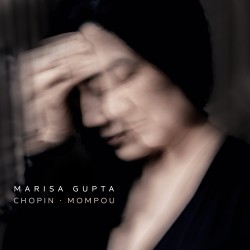
Chopin • Mompou
Marisa Gupta, piano
26th February 2027
AV2817
£13.49 1CD & Digital - Pre-Order
Summary:
To pair Mompou and Chopin is to enter a world in which small forms — preludes, dances, songs without words, fragments, variations — carry an expressive weight more often associated with larger structures. This recording celebrates a different idea of musical greatness: not the greatness of grandeur, development, and architectural breadth, but the poignancy of concentration and intimacy. These pieces challenge the assumption that profundity requires scale. They are brief, often elusive, intimate, but never slight. Their depth lies in how much they communicate with so little.
The prelude is central to this idea. Before it became a fixed, titled composition, preluding was an act: a way to begin, test sonorities and touch, create an atmosphere, and find one’s way into music. Chopin’s Preludes, Op. 28, transform these improvisatory roots into an opus of finished works. Rather than introductions to something else, they are complete, autonomous pieces. Yet they retain the spirit of preluding: the aura of music discovered in the moment. In this lies one of their paradoxes. They are fixed works that recall the freedom of spontaneous creation.
This paradox is part of a larger history. Lydia Goehr has argued that the modern concept of the musical “work” crystallised around 1800, shaping ideas of fidelity, permanence, and authorship that still govern classical music culture. Chopin’s Preludes seem to belong both to that world of fixed musical works and to a more ephemeral, less rigid practice of musical utterance.
Across the twenty-four Preludes, Chopin creates a complete expressive universe: tumultuous, lyrical, devotional, dance-like, and at times startlingly concise. Their brevity is not an absence of form, but a different kind of form — one in which character, gesture, atmosphere, and harmonic direction replace large-scale argument.
Mompou’s relationship to Chopin belongs to this same world. The Trois Variations show his gift for transformation on an intimate scale. In the later Variations sur un thème de Chopin, the affinity becomes explicit. Mompou takes the A major Prelude, Op. 28, No. 7 — already one of Chopin’s most concise statements — and transforms it through his own aesthetic of introspection, resonant harmonies, and sense of nostalgia. The work pays homage not only to Chopin’s theme but also to genres associated with Chopin: mazurka, waltz, nocturne, étude, prelude, and even a quotation from the Fantaisie-Impromptu. There are also allusions to other composers close to Mompou’s imagination, including Schumann and Scriabin.
The parallels between Chopin and Mompou are not only compositional but also biographical. Chopin’s adult artistic life unfolded in Paris, where he moved among salons and aristocratic circles while remaining profoundly marked by Poland — its dances, rhythms, and inflections. Mompou, born in Barcelona to a Catalan father and French mother, was similarly formed between cultures. He first moved to Paris in 1911, studying harmony with Marcel Samuel-Rousseau and piano with Ferdinand Motte-Lacroix, who became an important advocate of his music. After returning to Paris in 1920, Mompou received early recognition through Motte-Lacroix’s performances and the support of figures such as Émile Vuillermoz and Ricardo Viñes.
Mompou’s and Chopin’s shared affinity for the miniature is striking. Chopin’s genius found some of its most characteristic forms in the prelude, mazurka, nocturne, waltz, and étude. Mompou’s output, too, gravitated toward piano miniatures and songs, and his aesthetic ideal was bound to simplicity: recomenzar, to “begin again,” and the pursuit of “maximum expression with minimum means.”
Mompou is often associated with silence, simplicity, and inwardness, with many parallels drawn to Satie. Yet his sensibility is deeply Romantic. His harmonic language may be related to early twentieth-century French music, but his expressive world is intimate, tender, and flexible, with moments of great poignancy. Mompou’s music, though often spare and idiosyncratic in notation, depends on a performer’s ability to understand what the score cannot fully indicate. His markings are often sparse and his textures simple, but the expressive demands are deep.
This becomes clearest in Mompou’s own playing. His recordings reveal a pianism freer than many modern performances of his music: rubato, desynchronisation of the hands, un-notated arpeggiation, delayed melodic arrivals, rhythmic flexibility, and subtle shifts of sonority. Much of what he does would be impossible, or at least impractical, to notate fully. In L’expressió, his text on interpretation, Mompou writes that expression involves displacing the “sensitive note” from its metronomic place, with movement flowing over the rigour of the bar. A close study of his own words on interpretation as well as his playing points not to rubato floating above a fixed accompaniment, but to a more complete flexibility of musical time.
Composer Julian Anderson has written powerfully about the importance of Mompou’s recordings, calling them “a vital supplement” to his scores and describing the later interpretations as resisting the modern trend “towards literalness.” Anderson’s point is crucial: without the recordings, Mompou’s notation can be mistaken for something much plainer, more static, or more literal than it is. The recordings reveal how much expression and lyricism can be drawn from the apparent simplicity of the printed page, and they offer essential evidence for understanding his expressive world.
My own performances are informed by Mompou’s playing, but they remain more closely tethered to the score than his recordings often do. What I take from Mompou is not so much a set of liberties to reproduce, but rather a spirit to capture: an approach to timing, resonance, delayed arrival, and expressive freedom. While I do not imitate his playing style to the letter, I aim to retain a flexible approach to rubato and phrasing that remains my own while also remaining faithful to the spirit of his music-making.
In that sense, Mompou’s playing brings us back to the roots of the prelude — not the prelude only as a noun, a fixed work, but preluding as a verb: an act of sounding, searching, and beginning. In this lies the connection between Trois Variations, the Variations sur un thème de Chopin, and Chopin’s own Preludes. All three ask the listener to value the ephemeral and to hear the miniature not as a lesser form, but as a complete poetic statement.
Tracklist:
FREDERIC MOMPOU (1893–1987)
Trois Variations
1. I. Thème. Simplement
2. II. Les soldats. Temps de marche
3. III. Courtoisie. Très aimable
4. IV. Nocturne. Lentement modéré
Variations on a Theme of Chopin
5. I. Theme. Andantino
6. II. Tranquillo e molto amabile
7. III. Gracioso
8. IV. Lento, para la mano izquierda
9. V. Espressivo
10. VI. Tempo di mazurka
11. VII. Recitativo
12. VIII. Allegro leggiero
13. IX. Andante dolce e espressivo
14. X. Valse
15. XI. Évocation. Cantabile molto espressivo
16. XII. Lento dolce e legato
17. XIII. Galope
18. IX. Epílogo
FRÉDÉRIC CHOPIN (1810–1849)
24 Preludes, Op. 28
19. Prelude No. 1
20. Prelude No. 2
21. Prelude No. 3
22. Prelude No. 4
23. Prelude No. 5
24. Prelude No. 6
25. Prelude No. 7
26. Prelude No. 8
27. Prelude No. 9
28. Prelude No. 10
29. Prelude No. 11
30. Prelude No. 12
31. Prelude No. 13
32. Prelude No. 14
33. Prelude No. 15
34. Prelude No. 16
35. Prelude No. 17
36. Prelude No. 18
37. Prelude No. 19
38. Prelude No. 20
39. Prelude No. 21
40. Prelude No. 22
41. Prelude No. 23
42. Prelude No. 24
Related Releases: